


In many workplaces, hazardous substances are part of everyday operations. Cleaning products, solvents, paints, dusts, fumes, gases and biological agents can all pose risks if they are not properly identified and controlled.
The Control of Substances Hazardous to Health Regulations 2002 (COSHH) requires employers to assess these risks and put suitable controls in place.
A fundamental first step is being able to tell one hazardous substance from another and understand the specific dangers each one presents.
The Risks Of Misidentifying a Substance
Misidentifying a substance, or failing to recognise a hazard at all, can lead to incorrect handling, inadequate protective measures and ultimately illness or injury.
UK statistics underline the ongoing impact of work-related exposure. An estimated 11,000 lung disease deaths each year are linked to past exposures at work. These include conditions such as chronic obstructive pulmonary disease, lung cancer and mesothelioma.
Self-reported breathing or lung problems caused or made worse by work continue to affect tens of thousands of people, with thousands of new cases arising annually.
Occupational asthma and work-related skin disease also remain significant, often linked to chemicals, dusts and other substances that workers encounter.
When people do not know what they are dealing with, the likelihood of exposure rises and the effectiveness of controls falls.
How Hazardous Substances Are Identified
The primary way to identify hazardous substances in the UK is through the classification, labelling and packaging system known as GB CLP (the UK version of the Globally Harmonized System). Under this system, suppliers must classify chemicals according to their hazards and label them clearly.
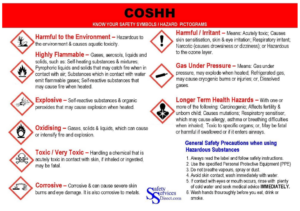
The most visible part of the label is the set of hazard pictograms; red-bordered diamonds with a black symbol on a white background.
There are nine of these pictograms, each indicating a different category of hazard:
- Exploding bomb – explosive substances
- Flame – flammable substances
- Flame over a circle – oxidising substances that can intensify fire
- Gas cylinder – gases under pressure
- Corrosion – substances that can damage skin, eyes or metals
- Skull and crossbones – acute toxicity
- Exclamation mark – less severe health hazards such as irritation or skin sensitisation
- Silhouette with starburst – serious longer-term health hazards (for example carcinogenicity, respiratory sensitisation or reproductive toxicity)
- Dead tree and fish – environmental hazards
These pictograms give an immediate visual cue, but they are only the starting point.
Labels also carry a signal word: either “Danger” for more severe hazards or “Warning” for less severe ones; along with specific hazard statements (often called H-statements) that describe the nature of the risk in more detail. Precautionary statements explain what to do to reduce the risk. Reading the full label is essential because a single product may carry more than one pictogram and several different hazard statements.
Using Safety Data Sheets
Even more detailed information is available in the Safety Data Sheet (SDS) that suppliers must provide for hazardous substances.
Section 2 of the SDS sets out the hazards identification, including the classification, pictograms, signal word and hazard statements. Other sections cover composition, first-aid measures, firefighting, accidental release, handling and storage, exposure controls and personal protective equipment, physical and chemical properties, stability and reactivity, toxicological information and ecological information.
A COSHH assessment should always draw on the relevant SDS so that controls are matched to the actual risks of the substance and the way it is used.
Substances Without Standard Product Labels
Workers also need to be aware that not every hazardous substance arrives in a neatly labelled bottle. Dusts generated during processes, fumes from welding or cutting, vapours from solvents and biological agents may not have a product label in the same way.
In these cases the employer’s COSHH assessment, workplace labelling, training and safe systems of work become the main means of identification and control. Older containers or secondary containers that have been decanted must still be clearly labelled so that the hazards remain visible.
Why COSHH Training Matters
Understanding how to tell substances apart is not just a matter of recognising symbols. It requires knowing where to look for information, how to interpret labels and Safety Data Sheets, and when to seek further guidance. Training plays a central role.
Under COSHH, employers must provide employees with suitable and sufficient information, instruction and training so that they understand the risks and the controls that apply to their work.
Our online COSHH training course is designed to give workers a clear, practical foundation. It covers what hazardous substances are, how they are classified, the meaning of the hazard pictograms, the health risks they can cause and the control measures that reduce those risks. The course is RoSPA-approved, available 24/7 on desktop, laptop or tablet, and provides a downloadable certificate on successful completion. Bulk discounts make it straightforward to train teams.
Being able to identify hazardous substances correctly is the foundation of effective control.
When people understand the labels, the Safety Data Sheets and the specific risks of the materials they work with, they are far better placed to protect themselves and others.
Combined with proper risk assessment, suitable controls and ongoing training, this knowledge helps reduce the burden of work-related illness linked to chemical and other hazardous exposures.